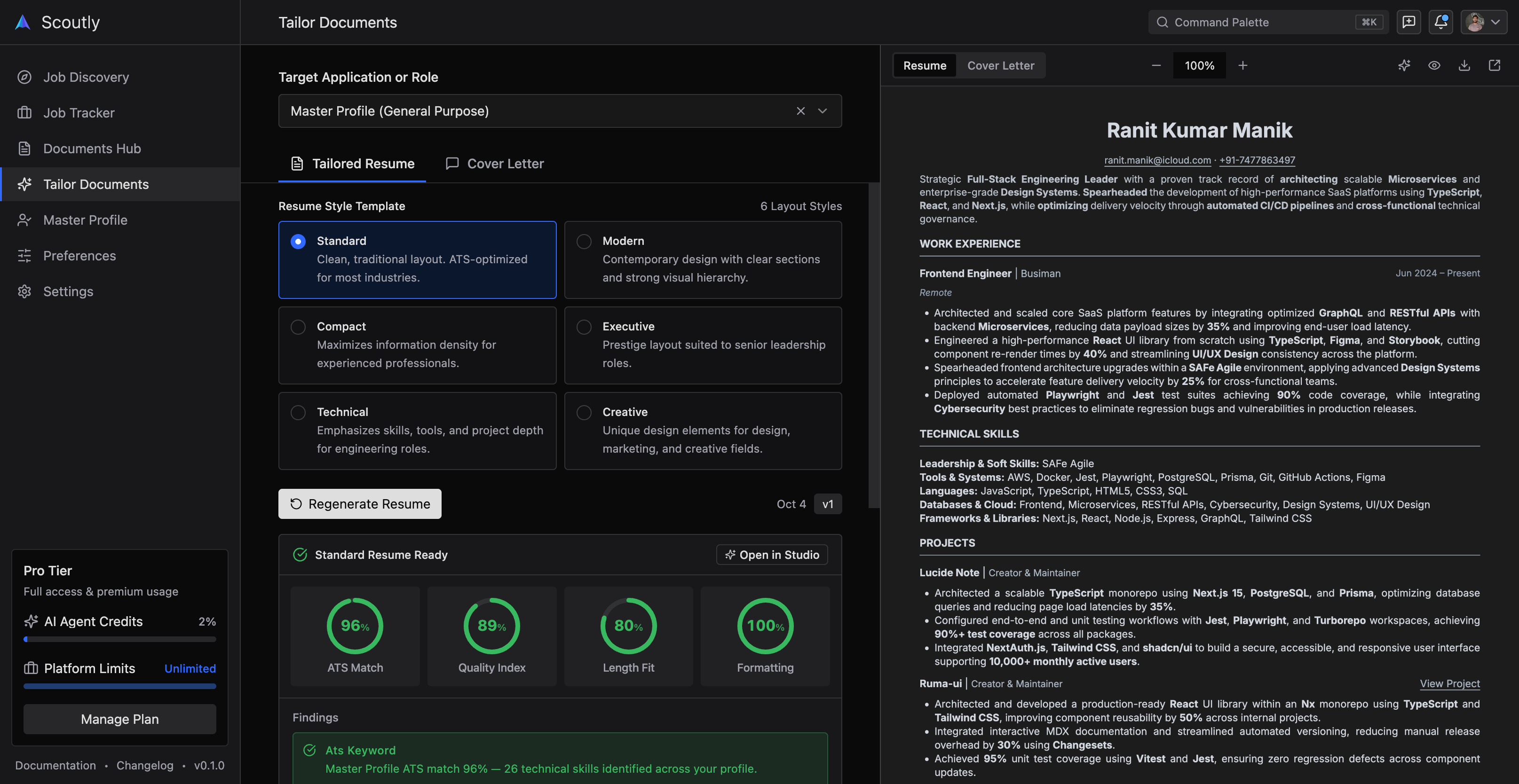
1. How ATS Algorithms Compare Resumes to Postings
Modern applicant tracking systems do not evaluate candidate documents like human recruiters. Scoutly runs an automated five-pillar audit simulating the exact tokenization, weighting, and extraction pipelines of Fortune 500 hiring software:
Hard Skills & Tech Stack Overlap
Cross-references languages, frameworks, cloud infrastructure, databases, and system design competencies against the 824-skill canonical taxonomy. Identifies missing high-frequency must-haves.
Role Seniority & Scope Calibration
Extracts requested years of experience and target seniority tier (Entry, Mid, Senior, Lead, Staff, Principal) from the posting and verifies your career tenure and leadership scope.
ATS Keyword Density & Phrasing
Scans non-stopword domain terminology, architectural phrases, and methodologies repeated by the hiring team to prevent automated filter drop-off.
Soft Skills & Operational Competencies
Audits cross-functional collaboration, technical communication, product sense, mentorship, and sprint delivery signals across your work experience bullets.
Education & Credential Requirements
Parses academic degrees (BS, MS, PhD) and industry certifications specified in the job posting to ensure minimum qualification compliance.
2. ATS Passing Benchmarks & Candidate Score Rubrics
Enterprise recruiting filters use quantitative score bands to automatically separate tier-1 applicants from automated rejections before a recruiter opens the review queue:
Optimal Interview Dispatch Band
Meets all core hard skill requirements, aligns with target seniority, and incorporates high-density domain phrasing. Highest probability of passing automated screening directly into recruiter review.
Competitive Match with Addressable Gaps
Strong baseline background, but missing 2–4 critical technical keywords or specific methodologies emphasized in the posting. Adding missing terms typically boosts callback rates by 3×.
High Screening Rejection Risk
Substantial misalignment between candidate experience and role requirements. Core tech stack or seniority gaps will likely trigger automated ATS rejection before human evaluation.
3. Supported Systems & Market Share Calibration
Different applicant tracking platforms, enterprise job portals, and startup ecosystems run distinct parsing and ranking models. Scoutly benchmarks your match across the 15+ primary hiring systems used worldwide:

Ashby
Enterprise ATS
Greenhouse
Enterprise ATS
Lever
Enterprise ATS
Workday
Enterprise ATS
SmartRecruiters
Enterprise ATS

Indeed
Global Network
Glassdoor
Global Network
ZipRecruiter
Global Network
Wellfound
Startups & Tech
Y Combinator
Startups & Tech
Instahyre
Curated Tech
Internshala
Early Career
Unstop
Early Career
RemoteOK
Remote Global
Apna
Regional TechUniversal Heuristic Parsing Engine
Applying through a custom internal portal or proprietary ATS? Scoutly's universal heuristic parser checks standard resume sections, contact hierarchy, and skill taxonomy density recognized across all enterprise hiring software (including Apple, Netflix, and bespoke corporate portals).
4. Four Fatal Traps That Cause Automated Match Rejections
Most qualified candidates are disqualified before a human reviews their profile due to these high-frequency structural formatting and keyword matching mistakes:
Invisible White Text Keyword Stuffing
Hiding job description text in 1pt white font fails immediately. Modern ATS parsers strip all color styles and render plain text directly into recruiter review dashboards.
Missing Canonical Taxonomy Synonyms
Writing 'ReactJS' when the ATS looks for 'React', or 'GCP' instead of 'Google Cloud Platform'. Scoutly maps 824 canonical entities across known industry aliases.
Seniority & Tenure Ambiguity
Failing to articulate years of experience or scope for Senior/Lead roles triggers automated junior filtering. Align your job titles and tenure indicators with target seniority.
Ignoring Required vs Preferred Distinctions
Treating nice-to-haves with the same weight as mandatory requirements. ATS algorithms prioritize hard must-haves—failing one critical skill can tank your composite score.
5. Four-Step Match & Optimization Lifecycle
Diagnose keyword gaps and skill discrepancies in seconds, then convert findings into tailored applications inside Scoutly:
Ingest Resume & Posting
Stateless In-Memory Parser
Upload your PDF/DOCX resume or paste your text alongside the target job description. Zero sign-up required, zero persistent tracking.
Map Skill Taxonomy
O(1) Alias Resolution
Our engine parses both documents in memory, extracting canonical technologies, frameworks, tools, and seniority signals.
Multi-Pillar Match Audit
5-Dimension Scoring
We compare required qualifications against your credentials to calculate hard skill overlap, keyword density, and seniority alignment.
ATS Optimization Plan
Deterministic Feedback
Receive a prioritized roadmap of missing keywords, section-by-section advice, and 1-click copy to tailor your application instantly.
6. Technical Market Comparison
How Scoutly's free in-memory job description matcher compares against legacy keyword counters:
| Capability | Scoutly Matcher Engine | Legacy Keyword Scanners |
|---|---|---|
| Canonical Skill Taxonomy | 824 normalized skills with alias matching | Naïve exact-string matching or raw word count |
| Required vs Preferred Differentiation | Detects required vs nice-to-have qualifications | Treats all words in posting identically |
| Seniority & Experience Fit | Calibrates requested years vs candidate history | No seniority awareness |
| Data Privacy & Persistence | 100% ephemeral in-memory scan (Zero PII stored) | Stores resumes for training and third-party data broker sales |
| 1-Click Tailoring Integration | Direct sync into Scoutly AI Resume Copilot | Disconnected text summaries |
| Daily Free Usage | 100% free with generous daily quota | Paywalled after 1 or 2 scans ($20–$50/mo) |
7. Frequently Asked Questions
How does the Job Description Matcher calculate my ATS match score?
The score is calculated across 5 weighted pillars: Hard Skills & Tech Stack Overlap (40%), Role Seniority Fit (20%), Keyword Density & Terminology Mirroring (20%), Soft Skills & Operational Competencies (10%), and Education Requirements (10%). Skills are matched against Scoutly's 824-skill canonical taxonomy, meaning synonyms like 'ReactJS' and 'React' or 'K8s' and 'Kubernetes' are recognized seamlessly.
What is the difference between 'Missing Critical' and 'Missing Secondary' skills?
Missing Critical skills are competencies listed under required qualifications (e.g. 'Must have 5+ years of Go and PostgreSQL') or mentioned repeatedly throughout the job description. ATS algorithms score these heavily. Missing Secondary skills are listed under 'Preferred', 'Bonus', or 'Nice to have' sections—they boost your ranking but are not strict disqualifiers.
Is my resume or job description saved on your servers?
No. Scoutly operates under a strict privacy-first, zero-persistence model for free tools. Your documents are analyzed in memory and immediately discarded. Results are stored exclusively in your browser tab's sessionStorage.
What ATS match score do I need to receive an interview callback?
Generally, a score of 75% or higher places your resume in the top quartile of automated ATS rankings, significantly reducing the chance of rejection by filters like Workday or Ashby. Scores above 85% represent near-perfect alignment with the hiring team's core criteria.
Can I just paste missing keywords into white text or hidden sections?
Never do this. Modern ATS platforms (Workday, Greenhouse, Ashby) strip formatting and extract raw plain text into the recruiter's UI. Hidden text appears as an obvious spam block in the recruiter's candidate overview, leading to immediate disqualification. Instead, weave missing skills naturally into your Work Experience accomplishment bullets and Skills section.